


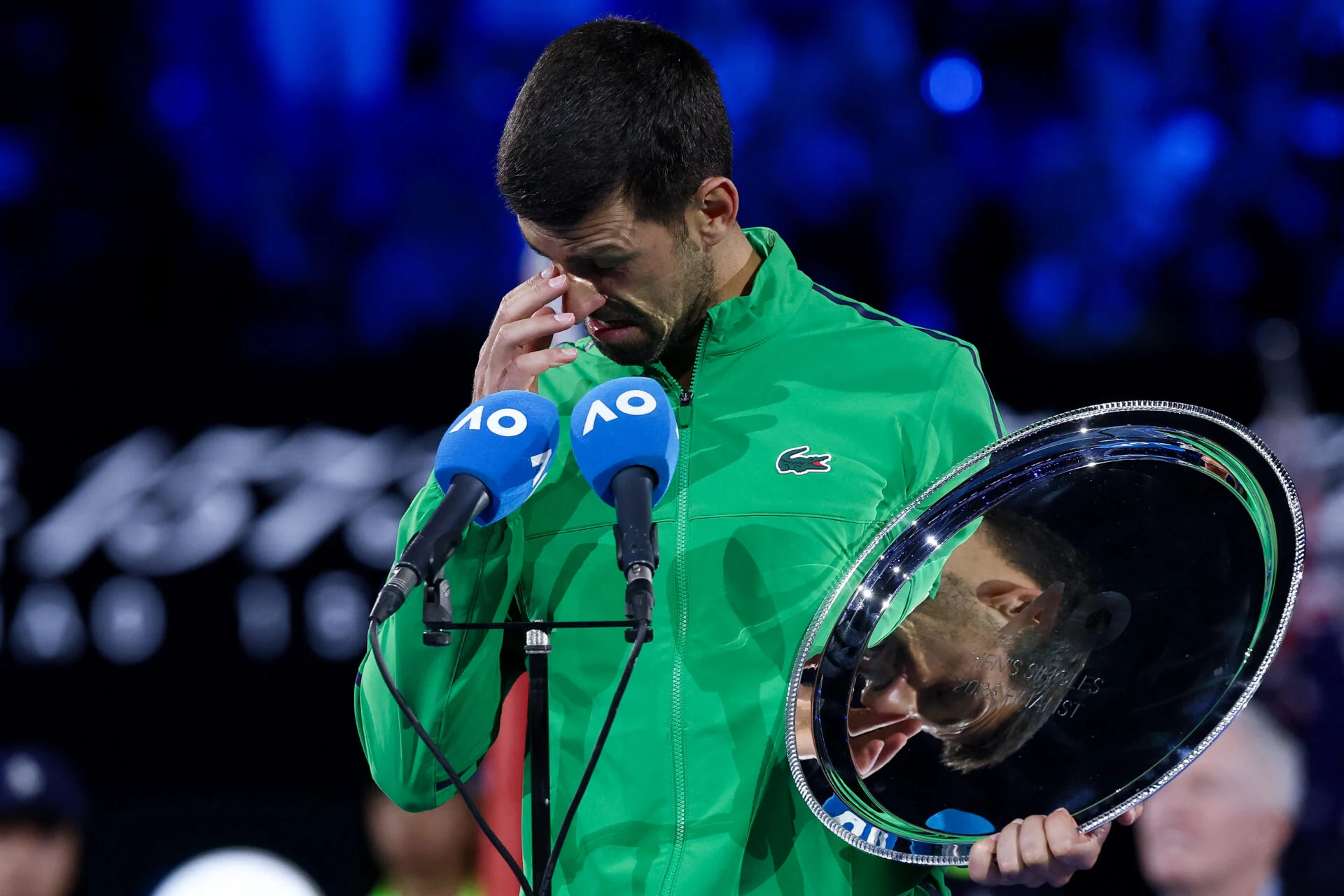
Andy Roddick was no stranger to a Grand Slam runner-up speech during his career, having lost four of his five major finals.
The last American man to win a Grand Slam, Roddick triumphed at the 2003 US Open, but followed that up with four successive major final losses. Three arrived at Wimbledon and the other at the US Open, but all four defeats remarkably came against Roger Federer.
With the 2026 Grand Slam season now over, former ATP number one Roddick has discussed what happens in the immediate aftermath of finals, giving his opinion on the runner-up speeches in particular.
| Result | Year | Tournament | Surface | Opponent | Score |
| Win | 2003 | US Open | Hard | Juan Carlos Ferrero | 6–3, 7–6(7–2), 6–3 |
| Loss | 2004 | Wimbledon | Grass | Roger Federer | 6–4, 5–7, 6–7(3–7), 4–6 |
| Loss | 2005 | Wimbledon | Grass | Roger Federer | 2–6, 6–7(2–7), 4–6 |
| Loss | 2006 | US Open | Hard | Roger Federer | 2–6, 6–4, 5–7, 1–6 |
| Loss | 2009 | Wimbledon | Grass | Roger Federer | 7–5, 6–7(6–8), 6–7(5–7), 6–3, 14–16 |
Andy Roddick offers simple solution for Grand Slam runner-up speeches
Speaking on his Served podcast, Roddick said: “Giving a speech in your worst moment… it’s not easy. You know, the only time I’ve really, really, really, really struggled was ’09 Wimbledon. Like, I knew if I broke that it was over, right? If I got emotional, that I wasn’t going to be able to get through it. And so you just kind of head down.
“There are two things. It’s impossibly difficult, and you can focus on that part of it, and in that moment, where people know that you are torn apart, if you are even just okay, you’re going to get a lot of credit and change a lot of minds about you.
“I thought Ben Shelton and the speech he gave was maybe his best front-facing moment that I’ve ever seen post-US Open. I thought the things he said, I thought who he said them to, I thought the fact that both of the players went to the other teams. I thought, kind of, the post-mortem of the US Open right after it finished, I thought they were both fantastic.
“So, it does suck. It’s not the easiest thing. If you can get through it and deliver something of substance, something authentic, something emotional, I think it does a lot for the way that people view you, but that might just be me, maybe I’m too close to it.
“I think I’ve come to a conclusion on, should they, shouldn’t they? It should just be the option of the runner-up. I’m sorry, I’d like to say thanks to my team. Thank you for the opportunity, or I don’t think I can do it right now. I don’t know. Pretty simple. I know the TV networks won’t like that. But it is what it is.”
Which American man has the best chance of winning a Grand Slam title?

It’s a fair point from Roddick, who knows more than most how difficult it is to recover that quickly and speak honestly after such heartache. While many fans will want to hear from beaten finalists, runner-up speeches are often not particularly interesting or groundbreaking, with the losers simply wanting to leave the court as soon as possible.
It does, of course, make matters worse when the finalists are made to hang around while the courts are being prepared for the trophy presentations, and people like tournament directors also take to the microphone.
Leaving it up to the player is a smart plan, but as Roddick mentioned, it won’t please the powers that be, and is therefore unlikely to be implemented anytime soon. The situation is, of course, not limited to Grand Slams, with runner-up speeches a common theme throughout the entire ATP and WTA seasons.
Receive exclusive tennis news and updates twice a week to your mailbox
 Add to Preferred Sources