


With the final event of the 2026 PGA Tour season underway, The RSM Classic is giving gear fans a clear preview of what’s around the corner for the new year.
A common theme among equipment manufacturers on-site at Sea Island Golf Club is a renewed focus on hybrids. While hybrids have been staples of brand launches for decades, it has been a few years since they commanded this much attention at the tour level, especially with high-lofted fairway woods (like 7- and 9-woods) recently stealing bag slots on Tour. At Sea Island, both Titleist and Callaway already had brand-new models in pros’ bags.
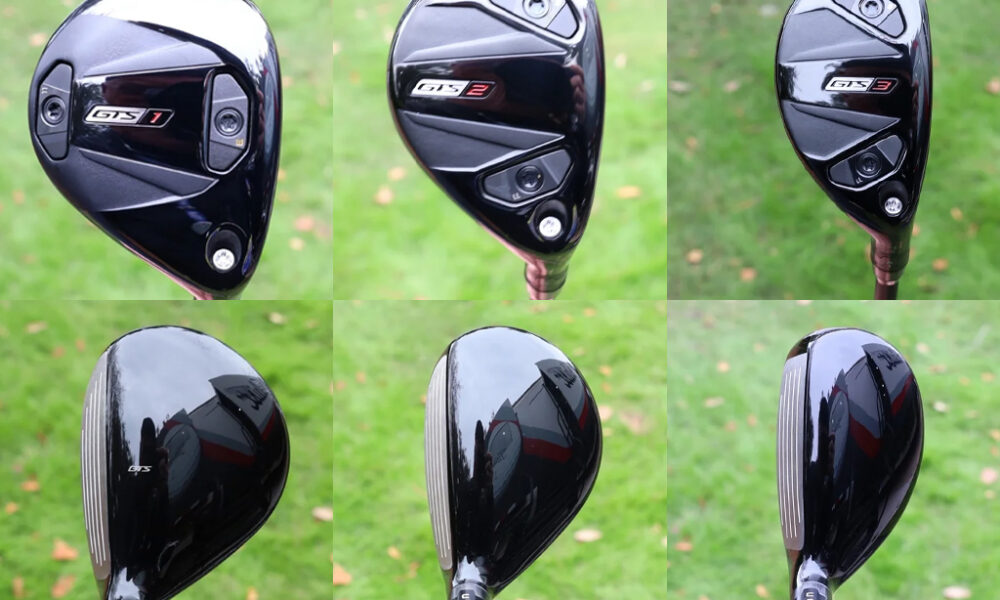
Titleist officially began Tour seeding for its new GTS hybrid lineup (also debuting simultaneously at the LPGA’s CME Group Tour Championship). The release includes the GTS 3, GTS 2, and – for the first time in this metalwood generation – a GTS 1 model, which was omitted from the initial GTS driver and fairway wood launch. (In the previous GT generation, the “1” series was an off-cycle release, though it notably helped carry Cameron Young to a victory at The Players Championship earlier in 2026.)
Across the GTS hybrid heads, the profile becomes progressively more compact as the model number increases:
- GTS 1: The largest, most forgiving head, featuring swappable front-and-back sole weights. Looking at the USGA Conforming list it is available in the widest range of lofts – from 4- to 7-hybrid (20°, 23°, 26°, and 29°) – it plays almost like a compact fairway wood rather than a traditional hybrid.
- GTS 2: A mid-sized profile utilizing heel-and-toe sole weighting, offered in 3- through 6-hybrid lofts (18°, 21°, 24°, and 27°).
- GTS 3: The most compact, players-style head, also featuring heel-and-toe weighting, available strictly in 3- and 4-hybrid lofts (18° and 20°).
All three models carry over the silver-face aesthetic seen across the rest of the GTS metalwood family.
On the course, players are already seeing distinct performance benefits. During testing, Michael Brennan found that the GTS 2 spun less than his current 7-wood. Meanwhile, Doug Ghim tested the GTS 3 as a replacement for his 3-iron, noting that pairing “a graphite shaft with an iron head has never worked” for him. The GTS 3 gives him a lower-launching option without the left-miss tendency he experiences with a 7-wood.
Titleist wasn’t the only brand turning heads at Sea Island. During GolfWRX’s “What’s in the Bag?” coverage, Tour Photographer Greg Moore spotted an unreleased 23-degree Callaway Apex hybrid in Greyson Sigg’s bag.
Callaway’s last standard Apex hybrid launched back in 2021, followed by the Apex Ti Super Hybrid – which featured a precision-brazed titanium face. This new prototype appears to revert to a more classic, compact shape. While heavy strips of lead tape on the sole obscure some of the finer contours, the signature “step sole” looks noticeably less pronounced, if not at all. The head also incorporates a central sole weight – reminiscent of classic Adams Golf designs – and utilizes a multi-material construction where the face differs from the main body.

Of course, not every hybrid in play at Sea Island was cutting-edge tech. Jeff Overton has an older Mizuno CLK Fli-Hi hybrid into play – a model lineage dating back to the early 2000s.

It’s a fitting reminder of what makes hybrids unique in golf equipment: unlike drivers, where modern forgiveness and ball-speed gains are hard to ignore, a dialled-in older hybrid can still go toe-to-toe with the newest releases on Tour.
