


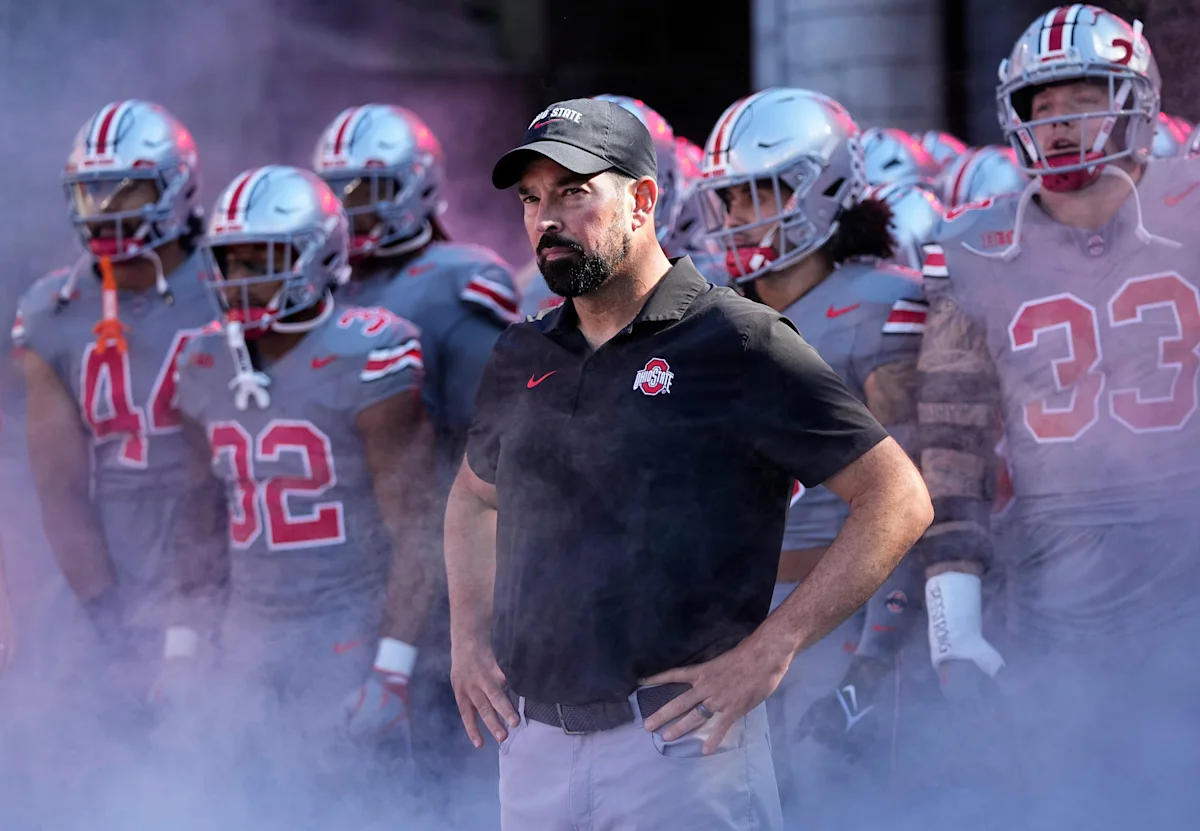
Beyond the crippling despair, angst, and frustration that the historic second-half collapse in Austin last Saturday created inside the souls of every member of Buckeye Nation, one of the most frustrating things about Ohio State’s defeat at the hands of Texas is that we now have to wait an entire month to see if the Buckeyes and their coaches can put the hard-learned lessons of the loss to the Longhorns into practice against another top-flight opponent.
With one week in the rearview mirror, Ohio State has four weeks before heading to Bloomington to take on the defending national champion Hoosiers and that is almost certainly a good thing for Ryan Day, Arthur Smith, Matt Patricia, the players, and everybody else who has spent the past week trying to pick up the pieces of the epic collapse. If you’re going to suffer an early-season loss, especially one that exposed some exploitable flaws in the current construction of your team, schemes, and execution, having five weeks to recalibrate before the next truly consequential game is about as favorable a schedule as you can ask for.
Advertisement
It is, however, deeply inconvenient for those of us who would prefer immediate answers and redemption. Did the defense learn that taking its foot off the gas against elite competition is a terrible idea? Will Ohio State find ways to get receivers not named Jeremiah Smith involved in the passing game? Can the offensive line figure out how to protect Julian Sayin long enough for him to find receivers not named Jeremiah Smith? Will the young, uber-talented Buckeyes get more playing time in high-leverage situations? Will the Buckeyes hit a meaningful field goal ever again?
Those are just some of the questions that I want to know the answers to; unfortunately, playing Kent State probably isn’t going to answer many of them.
Ohio State is favored to beat the Golden Flashes by 52.5 points today, and the gold standard of college football analytics, SP+, projects a 53-0 score. Nothing that happens against Kent State is going to prove that the Buckeyes have solved the problems that cost them a game against one of the best teams in the country that they had no business losing, but that doesn’t mean the game is meaningless.
In fact, Saturday is where the story of Ohio State’s post-Texas recalibration has to start, not only because it is simply and logistically the first game after the loss, but because it will give the Buckeye coaches and players an opportunity to make decisions for the future growth and success of the team.
Advertisement
Do Day and Arthur Smith continue to be creative offensively even after getting a lead? Does the defense consciously make an effort to bring more pressure on opposing quarterbacks? Are there schematic changes on both sides of the ball that can put the Buckeyes’ most talented players in better positions to make plays? Are young players who flashed in Austin rewarded with bigger roles? Do we see different lineups and rotations on offense and/or defense?
If we get encouraging signs in relation to any of those questions against the Flashers, that doesn’t mean that Ohio State is immediately ready to win a national championship. In fact, none of the data we get against Kent State, Illinois, or Maryland can truly be considered an answer to any of the problems continually haunting the Buckeyes. The trip to Kinnick Stadium on Saturday, Oct. 3 could provide a few answers, especially for the offense, but that doesn’t mean that the four games between Texas and Indiana don’t have value. If nothing else, they should give us a glimpse into what the coaching staff believes needs to change following the loss.
Rarely (if ever) does it seem like the OSU staff agrees with the fans and the Buckeye blogosphere about what the program’s pressing issues are following a loss — which is good, because they should clearly know far more about the team than we do — but when the same issues continue to creep up in big spots year after year, I do think that the fanbase is justified in looking for concrete evidence that the staff understands the things that are glaringly holding the team back.
There is always a tendency after a loss like the one to Texas to treat the next game as some sort of referendum. If Ohio State wins 63-3, then everything is fixed. If Kent State scores 17 points, then the sky is falling, the season is over, and somebody needs to be fired before the team leaves The Shoe. Neither reaction is especially useful, especially against an overmatched opponent like the Golden Flashes.
Advertisement
The goal of a game like that should be far more focused on process than proof. Kent State gives the Buckeyes a chance to experiment without much risk. Ohio State can test different personnel groups, alter tempo, manufacture touches, play with aggressiveness, and generally spend three-plus hours trying out solutions to problems that became painfully obvious against Texas.
The problem isn’t that beating the next four opponents by 30, 40, or even 50 points is meaningless — that would obviously be a progressively wonderful outcome — it’s that the totality of weaknesses that Texas exposed almost certainly will never be stressed enough in those games to know whether they have actually been repaired.
Ohio State can continue that experimentation against a step up in competition the following week against Illinois, followed by another step up against a ranked Iowa team on the road on Oct. 3. Then, the Buckeyes can come back home and hopefully put it all together against Maryland before facing their next monumental test of the season against the Hoosiers.
We obviously aren’t going to have a complete understanding of the team’s response to the Texas loss for quite a while. Iowa on the road should provide the first legitimate checkpoint, as the Hawkeye defense always presents a formidable challenge regardless of opponent, and Iowa City inherently puts extra pressure on visiting squads. If Ohio State gets dragged into one of those classic Kinnick rock fights, we could learn quite a bit about how the Buckeyes respond when Plan A doesn’t work.
Advertisement
But even then, Iowa and Indiana are very different tests. By the time the Buckeyes head to Bloomington, Ohio State will have had five weeks and four games to fully absorb the Texas loss, identify what went wrong, make changes, test those changes, and decide which ones are worth keeping.
That is when the excuses run out and the answers are due. The Saturday, Oct. 17 game against Indiana will be the first opportunity to see how Ohio State responds to a well-rounded opponent with the full complement of lessons learned, adjustments, and philosophy changes that need to come out of the debacle in Austin.
Until then, we are simply biding our time and collecting evidence; Kent State is Exhibit A. We won’t leave Saturday knowing whether Ohio State has become more aggressive, more adaptable, more disciplined, or more willing to trust the talent on its roster when a game tightens up in the fourth quarter, but we might start to see what Day and his staff think the answers are. And after Texas, that is really about all that we can hope for over this next month.
Nothing that the Buckeyes can do on the field over this time is going to make anyone feel wholly healed from the Texas loss. No margins of victory against these four opponents can prove that Ohio State is truly capable of national title contention. None of that will happen until the Buckeyes do it against another A-level opponent, and that can’t happen until Bloomington.
Advertisement
This month is not about redemption; it is about recalibration. The Buckeyes’ check engine light went on in Austin, and now they have five weeks to figure out how to fix it. Kent State won’t tell us whether all the repairs worked, but it will tell us where Ohio State decided to start.
