


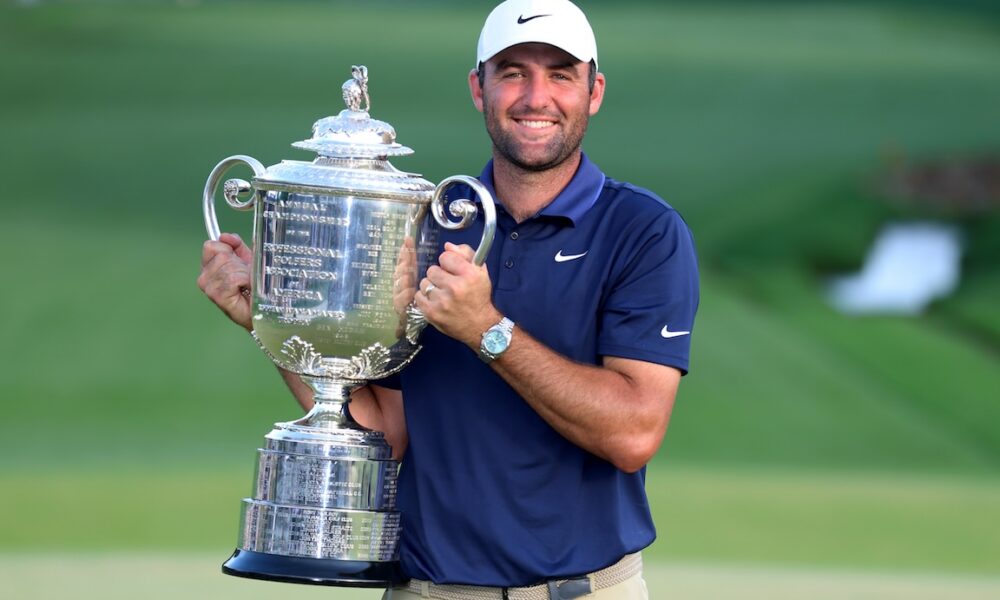
What a game we play in golf. Spanning hundreds of years of history, it offers us the chance to hit shots that the greats of the game have executed before us. The game is unrelenting and rewarding all at once. Before a round, or afterwards at the 19th hole, the topic of competition inevitably comes up: who would do what, and how good is someone really? The bets of, “If you gave me 6 months, I could be [insert player here],” are always flying around.
So with that, I’m putting on my talent evaluation hat, drawing from what I’ve seen in my experiences, and making some connections between a club scratch player, section professional, elite amateur, and touring professional.
This is a pretty broad topic, so depending on the feedback, we can always dive deeper. But for now, I’ll break it down into three overarching pillars: Ball Striking, Short Game, and Mental Game.
Apr 13, 2025; Augusta, Georgia, USA; Scottie Scheffler places the green jacket on Rory McIlroy during the green jacket ceremony during the final round of the Masters Tournament at Augusta National Golf Club. Mandatory Credit: Kyle Terada-Imagn Images
Ball Striking
When it comes to the sound of impact at the ball, each level of player tends to have a distinct sound. Sometimes you hear a high-pitched click at impact, other times a “thud” as the ball takes off. A scratch player at a club can produce that sound fairly often, but as we move up the chain in terms of golf skill, that distinct sound becomes even more consistent.
Distance is part of the equation, as each level of player here has certain strengths. Plenty of players hit it long these days, but it comes down to the consistency of their distance from a solidly struck ball to a mishit. Tour professionals have their mishits, too. For example, with an iron, that mishit might still reach the front of the green. For a club scratch, section professional, or elite amateur, that same mishit might leave them short of the green and reaching for a wedge. This can absolutely happen with tour pros as well, but overall, their mishits are just less volatile than those of other players. Think of when Hideki Matsuyama one-hands a finish on a swing and he’s still 20 feet from the hole—or sometimes even closer. What a showoff!
We can also apply this to the driver—mishits that still find the fairway are common for tour pros, elite amateurs, and section professionals, and occasionally for scratch players. But once again, the variance generally increases as skill and experience decrease. Every player has a big miss in the bag; the difference is how often it happens.
Distance control is another mark of a skilled player. Being pin high—even if the ball isn’t directly in line with the target—is a good hallmark of control. Being pin high is huge, though not always the best position depending on the hole location. The best players have a knack for hitting their target, and that doesn’t always mean it’s going to be close to the hole. You secure the par, give yourself a chance for birdie, and cut out the options for a higher score.

Short Game
An array of shots around the green is something you see from touring professionals. Sometimes, it’s just about taking care of business with a simple shot—but it’s mastered. They’re not always trying to play the hero shot when it’s presented. For example, if there’s a chance to really spin one with a wedge around the green, it may not be as fun or flashy, but it might be better to rely on the consistent play where the ball rolls toward the hole. Having these shots on command, and knowing what the lie dictates, is what separates all these levels of players. Everyone is capable of these shots, but it’s the consistency and execution that set them apart.
Putting is a game within the game. When I’ve played with tour pros, they roll the ball so well—it almost looks like it weighs 20 pounds on the green. Their speed control is typically a major strength, and the ball tracks toward the hole with purpose, but never with an aggressive tone. It’s a commitment to their process on the green. Elite amateurs, section pros, and scratch players share these characteristics, too, but the consistency can vary. I’ve fallen victim to this in tournaments—thinking my speed is dialed in, only to have a 20-footer for birdie turn into a 4-footer coming back out of nowhere. Any of these players can have that happen, but when it counts, the margin tightens.

Mental Game: Course Management & On-Course Demeanor
Here’s the overarching topic that ties together the facets above: course management. Despite which club might be the most fun to hit, it isn’t always the right play. Sometimes it is—because you believe it is, and that belief is the main ingredient. But it’s also about identifying the proper play and sticking to it. The answer depends on what events you’re playing in, too. A tour pro playing a four-round event is thinking about a long-term score and can adjust the game plan for the final round. For elite amateurs, is the tournament match play or a three-round stroke play? For a section professional, what’s at stake in the event? A scratch player might be playing a one-day event. All of these decisions need to fit the task at hand. Good course management takes the big number out of play—and it takes discipline to do that.
On-course demeanor is an intangible that carries exponential weight. Ever see a good player at the course who just looks like they belong? That’s just what they do. They play great, always in control, never caught off guard. That comes from experience and belief in themselves. I know each level of player can bring this on a given day, but can they bring it every day? That’s the difference. This goes beyond a great round—because it’s just as important, if not more so, when the round isn’t going your way.
The great players turn rounds that could have spiraled out of control into even-par—or even a couple under par. I think this speaks to the different levels of players mentioned here, and how they handle adversity when things don’t go to plan—and even when they do. We see this in low rounds on tour, or in rounds that could have been really low but finish in the mid-60s. That margin of score changes with each skill level.
The difference between these skill levels isn’t just one great shot. It’s the ability to have a solid day when it isn’t your best day, and to take advantage of scoring when it is your day. Each skill level has its own version of this, and it gets even more refined as each player keeps sharpening their tools. Safe to say, it’s time to go practice!
