


Editor’s note: This story is part of The Athletic’s coverage of SailGP, an international sailing competition that has been likened to Formula 1 on water. Follow SailGP here.
Even when the wacky Halifax weather hurls the wildest of curveballs at the SailGP fleet, somehow Tom Slingsby and the irrepressible Australians ride their magic carpet of consummate skill and a decent dose of luck to lead the standings after the first day of the Canada Sail Grand Prix.
This weekend’s event in Halifax, Nova Scotia, is the first time in SailGP’s six-year history the fleet has been split into two groups from the get-go. Where the group of 13 F50 catamarans would usually launch off the line in a mass start, Saturday saw Group A compete with seven teams, followed by Group B with six teams.
There had been a day of split-fleet racing on the Sunday of the New Zealand Sail Grand Prix in February, as a response to the horrendous crash in Auckland between the New Zealand and the French F50s. The idea is that splitting the fleet will reduce the traffic on the race course and reduce the chance of a nasty pileup.
But there has never been a whole weekend of split-fleet racing. SailGP’s movement in this direction has been reluctant. It’s logistically messy, and start lines of six or seven boats are not as spectacular as a full fleet of 13 jostling for position on a crowded line. But the three-way crash in New York is still fresh in the memory. So, with a tight race course set between the Halifax city waterfront and Dartmouth shoreline, and a forecast of gusts up to 20 knots, it was a reasonable call by the race committee to think “safety first” and opt for split fleets.
The 20-knot gusts never materialized, however, and very little wind showed up at all for the 90-minute broadcast window. With the benefit of hindsight, this is not the weekend SailGP would have chosen to begin the split-fleet experiment. Danish skipper Nicolai Sehested made no secret of his dislike for this move to separate groups.
“I hate split fleets,” he told The Athletic. “I think it’s a terrible way to go on television. People (in the grandstand) buy tickets for the show, and what we saw today … I would have asked for a refund right away.
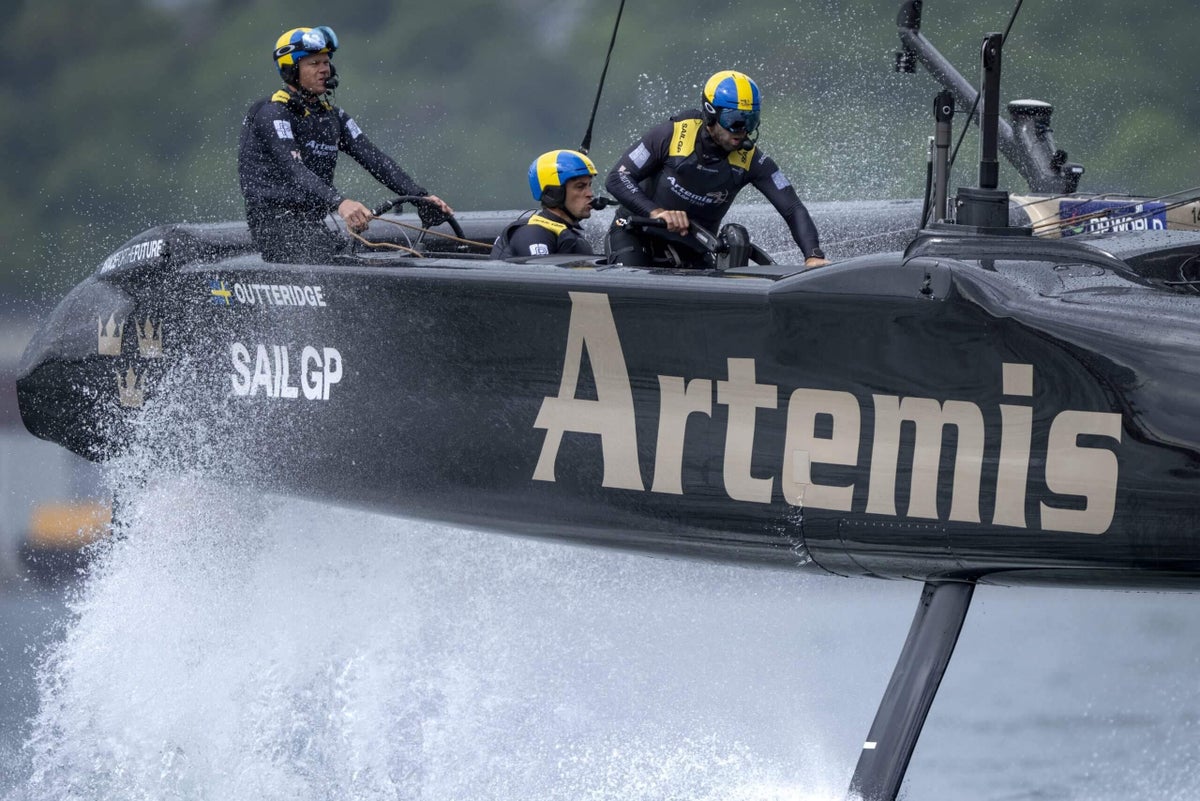
The Great Britain SailGP Team passes the grandstand on Race Day 1 of the Canada Sail Grand Prix in Halifax, N.S. (Jed Jacobsohn / SailGP)
“One fleet is more fun because there are multiple things going on, and it also makes it a bit more fair. We all have the same conditions, we all have the same racecourse. Whereas today, it was literally some having foiling races, some having nonfoiling races. I don’t know, I think split fleets are a waste of time.”
Others were more forgiving of the format change. Pete Burling told The Athletic: “It’s pretty impossible to be completely fair. I think it’s awesome when we’re out all together for the spectacle. Split fleets mean you lose some of the wind shadows on the course, so it kind of makes it a bit nicer at the bottom end of foiling conditions. With a lot more boats, it can be hard to foil around. There’s obviously lots of speculation either way on what’s safe or what’s not. But for me, it’s not massively different.”
What was massively different was the stark contrast in racing conditions for Groups A and B. When Group A raced, there was barely enough wind for any of the F50s to pop up onto the hydrofoils. Ten minutes later, a breath of wind arrived and the Group B boats were onto the foils and were at least achieving foiling for some of the time. And so it went for the second flight of racing. Halifax native and Canada’s flight controller Billy Gooderham offered his explanation of the methodical randomness to The Athletic:
“The wind was coming and going with the cloud cover clearing and then returning. We (the teams in Group A) got the vacuum and they (the teams in Group B) got the pulse, right? Our group got the bad luck of the draw. It’s just one of those things, but it’s frustrating.”
The follow-on from the split-fleet format is that Sunday, for the first time, there will be a SailGP winner-takes-all final not with three boats but with four. The top two teams from each of Groups A and B will progress to the final. Based on the overnight standings, that would be Australia and New Zealand from Group A, and Sweden and Switzerland from Group B. On Sunday, the other nine teams will fight to elbow their way past the current top four.
Slingsby acknowledged that the Bonds Flying Roos had enjoyed a modicum of luck, although there’s no denying that the Australians continue to set a benchmark that no other team can match. “It’s just one of those days where you say to the team: Things are going to get thrown at us, changes are going to be happening, and you just gotta roll with the punches,” he told The Athletic. “We did a good job today with that, and we were lucky as well.
“But it wasn’t the funnest day ever. It was frustrating because we had such beautiful wind before the start, and we were all expecting it to be really nice, and then the wind just faded away. I guess sometimes I put my CEO hat on and I just want a really quality product to go out there to the world, and so it was frustrating not to see that happen. But as a sailor, we sailed as well as we possibly could have, and we’ve got to be happy with that side of things.”
Sunday’s racing takes place from 3 p.m. to 4:30 p.m. ET, with two more races each for Groups A and B, concluding with the four-boat final. For more information, go to SailGP.com/halifax
