


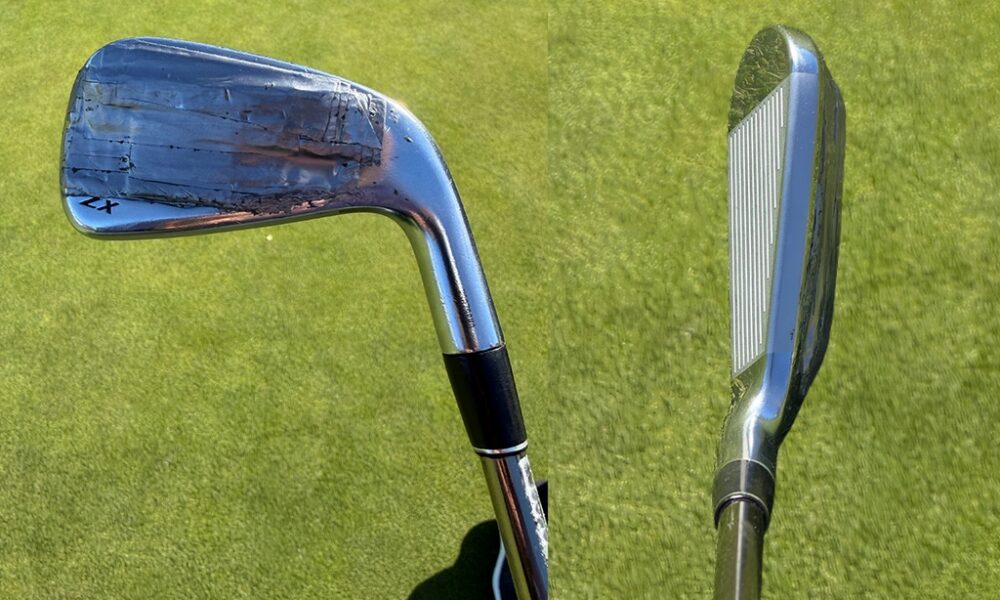
We have seen new clubs enter the market over the years. Hybrids, more options for high-lofted fairway woods, high-lofted 62-degree wedges, and mini-drivers. These movements start when someone looks to fill a void on the course. Are we on the brink of a new revolution?
Enter the mini diving iron. This came up recently when my friend Jason Welty said he was cutting his 2-iron down to 6-iron length. At his home course, there are very narrow tee shots, and his theory was that hitting it low with a full swing that is more in routine off the tee helps eliminate variables of being in trouble when the tee shot calls for being supremely accurate.
I got to hit this club as well, and it definitely fits the function of keeping the ball in play. The launch characteristics are similar to a traditional driving iron, but the height is reduced. The ball was launching at 7-10 degrees, with spin ranging from 3,000-4,500. The ball doesn’t carry high enough to keep it from going too far off-line. So even with a decent mishit, the ball can end up in the rough instead of the trees. I also hit one solid, and it carried 229 yards with a much lower landing angle. Great for when the wind is a factor, as you can swing your stock swing and the club is going to do the work in keeping the ball low.
This isn’t a club to have in the bag for every round, in my opinion. It is course-dependent, with the shots you need in your toolkit that day. We haven’t tried the club in firm conditions, but I think you could run into a scenario where the ball will roll too far. But when courses are a little softer and narrower, this club will have a ball flight that runs out in most scenarios.
I’m going to explore this further and try a traditional iron-set shaft for a little more weight and see how it performs this winter. This will be a cool test to see how this club fits in the bag in the bigger picture. I’m not sure this club will be the next revolution in equipment, but it absolutely might be worth a look!
