


He was born in the summer of his 27th year
Coming home to a place he’d never been before
He left yesterday behind him, you might say he was born again
You might say he found a key for every door
We need to be good enough. We don’t need to be legendary. We don’t need to be superlative. We simply need to be good enough at what we do, to accomplish the task. Without doubt, we would love to shine, to exhibit hall-of-fame skills and results, but those things are not necessary. On Sunday at Shinnecock Hills, Wyndham Clark missed par-saving putts from five feet on at least three occasions. He missed fairways by wide margins. He hit apparently-simple, approach shots long, resulting in bogey. Clark gave away six shots to Sam Burns, one of his pursuers, on the final day. On the 72nd hole, Wyndham Clark shook his head in disgust as his approach shot found the green, fifty-three feet from the flagstick. Two putts later, despite all the aforementioned misses, Wyndham Clark was the 126th United States Open champion, by one shot.
Wyndham Clark never lost faith. He might have exhibited moments of frustration, like the fairway bunker shot on number four. He gathered himself promptly, and recovered with a deft pitch to fifteen feet, then holed the putt for par. Those moments of exasperation, that remain with you and me, are quickly discarded and forgotten by the successful professional golfer. We do that in our professions, too, so should it surprise us that the pro golfer can do so? Remember this: the professional golfer does not spend weekends doing accounting, or teaching Spanish, or running a ward. No one does what we do, for recreation.
On the fifth hole, Clark was in the middle of the fairway, 210 yards from the hole. His iron hit the downwind green hard and shot well beyond the putting surface. His recovery pitch did not recover enough, and he was force to hit it again. He went well by the hole, and took two putts for bogey, on a hole from which he expected birdie. On the 13th hole, Clark attempted to knuckle a pitch to the green, to reduce spin and not rip the ball off the front of the green. His shot sailed just long enough to catch the back downslope, and again, he was faced with a recovery pitch. Another bogey, from the middle of the fairway, this time witg a wedge in his hand. At fourteen, Clark’s approach putt from thirty-three feet appeared irresistable to the hole, until it tilted gently right at the last moment, and stay grass side. At sixteen, Clark’s drive was reminiscent of his tee ball on two: left of everything, nearly to the North Fork. His recovery found the fairway, but his approach to the green was again too strong, reaching the back edge … and then he holed the putt. Does any of this make sense? No, it does not, but it is the game of golf, on the back nine, at the U.S. Open.
Six hundred and seventy-three yards from victory, with a two-shot advantage. Wyndham Clark found the green’s front-right quadrant, a safe but distant port across a turbulent carpet. Sixty-two feet remained, but his initial effort managed just fifty-six of them. Still, six feet is manageable, until the ball moves slightly left and misses the declivity. Bogey meant that he would need to make par over the final four hundred-ninety yards, to avoid a playoff.
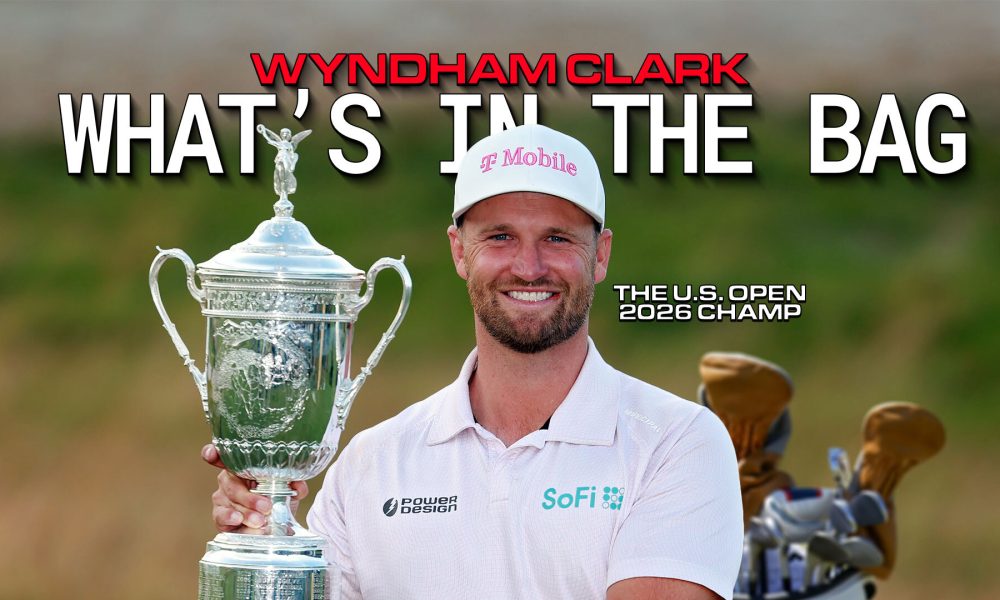
Wyndham Clark is strong. In the legs, the hips, the shoulders, and the arms. Most of all, in the heart and spirit. He must be, to continue on after the young loss of a mother, and loss of temper, just 363 days ago at Oakmont. He needed to be strong in all ways, on the final hole. His drive sailed rightward, into the rough that covers golf balls and ensnares hosels. He drove down through the recovery, and appeared dismayed with the shot. Not to worry, as the ball found the putting surface, fifty-three feet distant from glory. Eerily similar to the length that he faced, just ten minutes before. Eerily similar to the line that he attempted to traverse. This time, Clark’s line and speed cooperated, and he was left with less than a foot for par. For the second time in four years, Wyndham Clark raised the unnamed trophy and received the Jack Nicklaus gold medal, emblematic of the champion golfer of the hemisphere.
When he first came to the mountains his life was far away
On the road and hanging by a song
But the string’s already broken and he doesn’t really care
It keeps changing fast and it don’t last for long
