


You’d be surprised how few people actually roll credits when playing a game, but just look at the achievements, and you’ll see for yourself. 28.9 percent of Kingdom Come: Deliverance 2 players carved their way through Bohemia; just 23 put the Dreamscourge to rest in Avowed; and only 50 percent of Baldur’s Gate 3 players untangled the druid and goblin conflict in the very first act.
Developers are keenly aware of this discrepancy, as former Capcom, THQ, and Sega executive John Lee noted all the way back in 2011 that “only 20 percent of players ever finish a game.” At the time, he was referring to the state of things “ten years ago,” but another decade has passed, and little has changed.
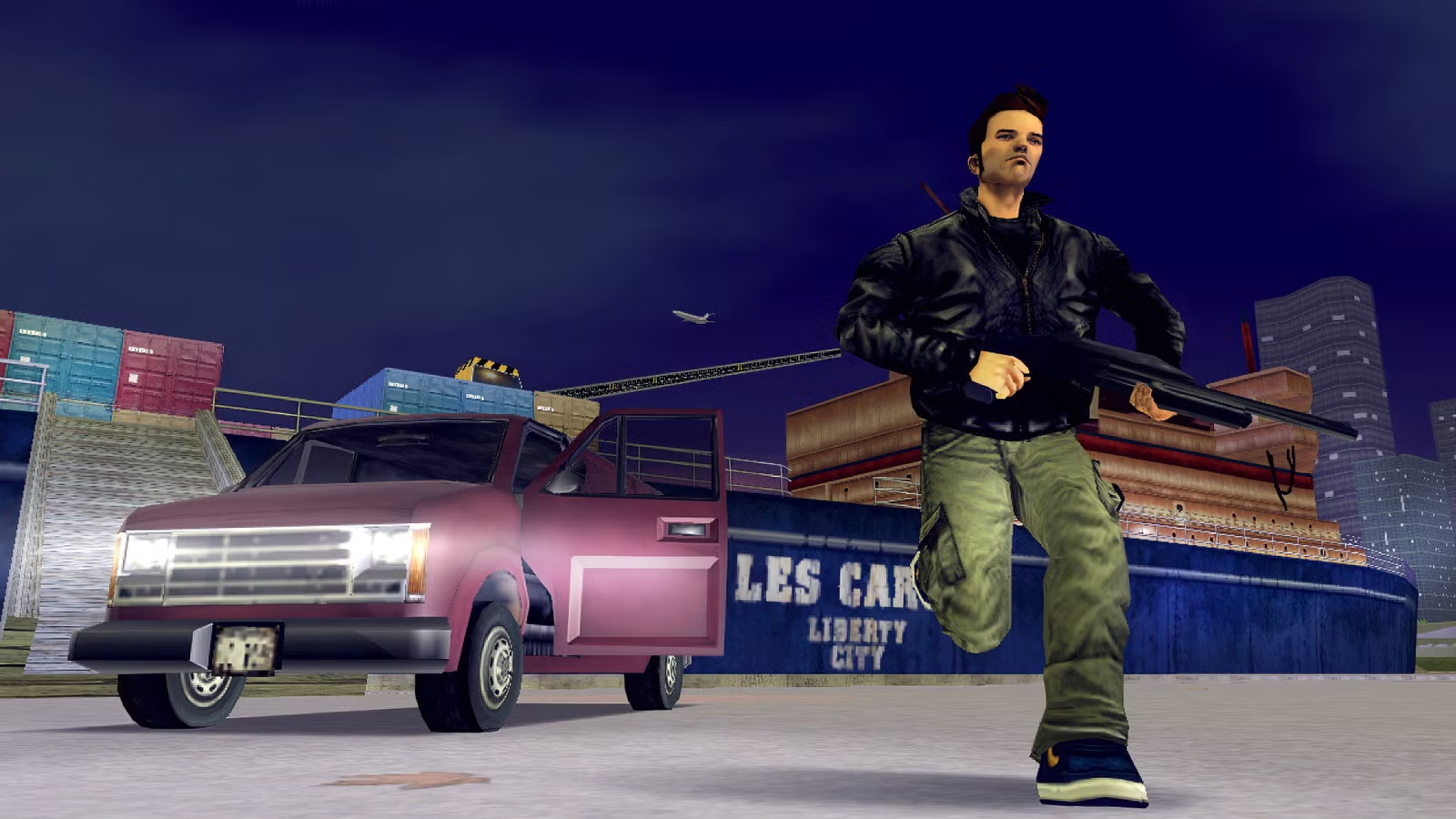
Rockstar co-founder Dan Houser, who also helped pen the script for every Grand Theft Auto game until he resigned in 2020, spoke at a panel at the Tribeca Festival in New York City this weekend about this exact problem. He revealed that one of the key goals for the studio was to get more people to reach the end of its games after the success of GTA 3, and surprisingly, they succeeded.
“The whole point of an open-world game is we provide guides,” Houser said (thanks, IGN). “We want you to experience the story. Our goal was always — from GTA 3 onwards — to try and get more and more people to finish the story. And the numbers went up and up; they used to be pretty level.”
Nearly Half Of Red Dead Redemption 2 Players Completed The Story
38 percent of players put together the homestead with John Marston in the Red Dead Redemption 2 epilogue (42 percent — nearly half of players — saw Arthur’s story through to its end in chapter six), while 29.42 percent completed the Big Score in GTA 5; that might not sound like a lot, but it’s above average, which is exactly what Rockstar was striving for.
This discrepancy isn’t nearly as bad in linear games, often hovering around 40–50 percent completion rates, with a staggering 72.1 percent of players fighting their way through Raccoon City in Resident Evil Requiem. But open world games are sandboxes with plenty of distractions to lure you off the beaten path. And while it’s understandable that a writer would want players to experience all their story has to offer, Houser admits that there’s far more to an open world than the narrative.
“Ultimately, that’s up to the player. The players enjoy being in the world, mucking around, doing whatever they want to do, messing with the systems,” he said. “The most fun thing about the game isn’t any rubbish we write, it’s the systems that we make. [What’s] always going to be the most fun is being in this world, seeing what happens when you jump off this building, when you punch that person, you drive that car, when you interact with this thing, or that thing, whatever way. That’s always gonna have a sort of magical quality to it, and we are on some level on the story side, just the icing on the cake.”

- Released
-
October 23, 2001
- ESRB
-
M for Mature: Blood, Strong Language, Violence
- Engine
-
RenderWare