


TAMPA, Fla. — The fireworks were literally going off during the first night of SEC media days. An impressive display over the water here in Tampa, befitting a July 4th celebration, but this occasion was merely the SEC media party.
While the SEC didn’t actually pay for them — the Tampa Bay Sports Commission did — it showed yet again why the conference motto (“It Just Means More,” if somehow you don’t know) resonates so much. This is the league that many believe can stand on its own — and is talking about doing just that.
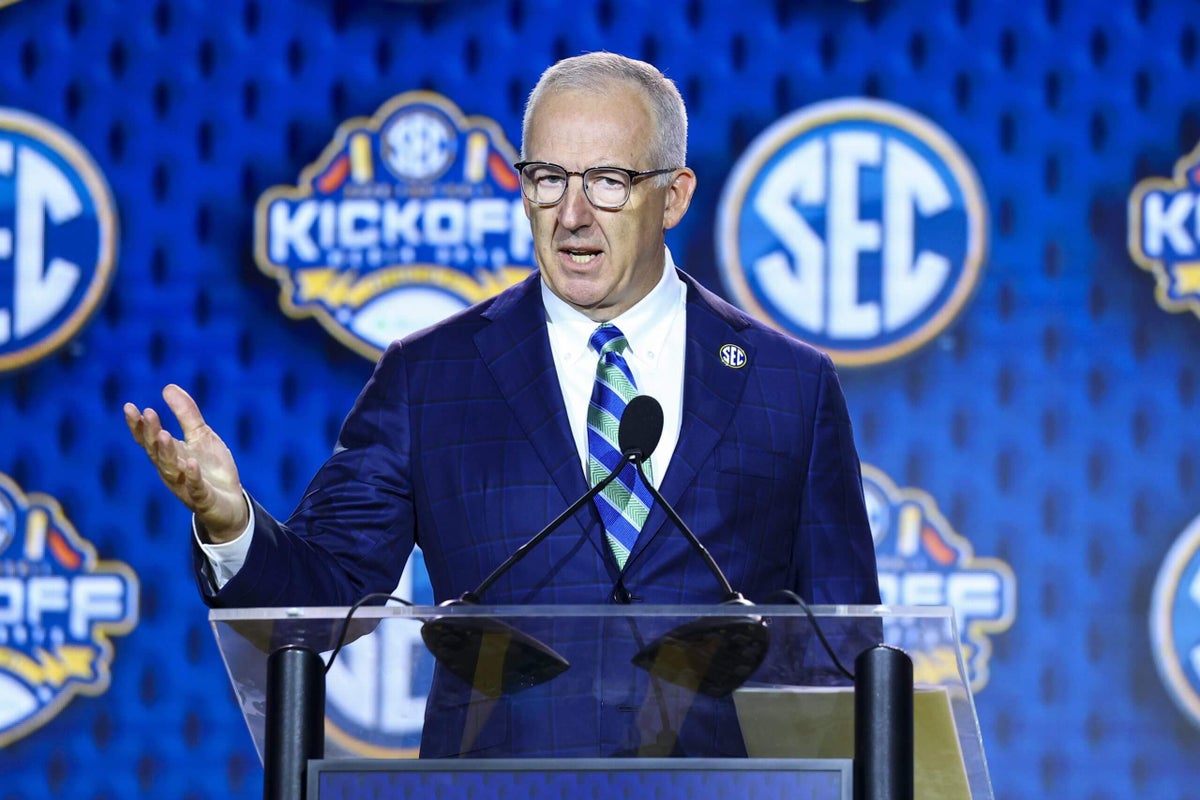
The idea of the SEC breaking away has been percolating for a while and was discussed seriously within the conference all year. It went public at meetings in late May, then got more life Monday when commissioner Greg Sankey, given a chance to downplay the idea, instead called the talk “real.”
And, according to multiple league sources, the idea is real and not just a leverage play. Still, if it happens, there are also ranges of how drastic an SEC breakaway would be.
The nuclear option
This would be real and spectacular: Breaking away to form an SEC football playoff, as Georgia coach Kirby Smart supported in May, and Georgia president Jere Morehead said would be “fantastic.”
There is less enthusiasm for doing so in other sports — Sankey pointed out the SEC won 13 NCAA championships this past school year — but in the nuclear option scenario, the conference would be prepared to make that trade-off, if it means freedom in everything else.
The freedom to make and enforce its own rules on anything it wants — including player pay and eligibility — and be accountable only to its league office, not the NCAA or newly formed College Sports Commission.
Florida athletic director Scott Stricklin outlined the reasoning in May: “I don’t think you can make up your own rules and still compete against others who are following different rules. So in effect, you are just saying we’re going to be SEC-centric in all things. I’m not advocating for that; I’m just saying that’s the mental, intellectual exercise you have to go down that path of when you start considering what it would look like.”
The mild option
This would be self-governance, a term that puts outsiders to sleep, but is discussed often within the SEC and college athletics. And as Sankey takes pains to point out, it has already been happening on some things.
The SEC used to have different rules on whether graduate transfers could play right away, for instance. Then court cases set up unlimited transferring for everybody.
Sankey’s point is conferences have always had their own bylaws and rules, and even enforcement. They’ve just been supplemental to NCAA rules and enforcement. When SEC leaders talk about self-governance, they mean making their own rules on more things, but they also mean doing so within the NCAA structure and coming to some nationwide understanding that conferences will be free to make and enforce their own rules on certain things.
Which things? Well, that may be hard to agree on, which is why a breakaway could happen — but short of the nuclear option.
Something in-between
In this scenario, the SEC withdraws from the House settlement — which created nationwide rules on revenue sharing and third-party payments to players — and sets its own rules on paying players. That could mean a salary cap, or even a luxury tax, which fits a conference that includes Texas and Mississippi State.
For example, the tax starts at $40 million: Anyone can spend more than that, and schools like Texas and LSU will, but they get taxed a certain amount over that $40 million, with that money going to the schools that spend less.
This is similar to Major League Baseball, where you have the Los Angeles Dodgers and Tampa Bay Rays. Yes, the Dodgers have won two straight World Series and spend a lot, and yes, MLB owners want a salary cap. Still, the Rays are in first place in the American League East.
Of course, MLB has a luxury tax, and other sports have salary caps, via collective bargaining with players. The SEC had a presentation at spring meetings on potential collective bargaining, which many believe is the only sure way that such rules on pay limits will withstand court challenges. There’s also the theory that the SEC stepping out on its own and setting such rules would withstand antitrust scrutiny because players have the option to play in other conferences.
And of course the SEC would not want to set this hypothetical salary cap/luxury tax too low and hurt its teams’ ability to recruit against non-SEC teams. Because it would also still be competing against those teams in the College Football Playoff, having not exploded the nuclear option.
An important side point
Two of the other power conferences, the ACC and Big 12, have been dismissive or side-eyed about the SEC talk. ACC commissioner Jim Phillips said earlier this month that “self-governance is no governance.”
The Big Ten, however, has been coy and would seem to be the only other league besides the SEC that could stand on its own. However, when SEC people are asked if they could work with the Big Ten on a breakaway, they always point out they could not work together for antitrust reasons.
Take from that what you will.
“We have to find a better way to govern ourselves,” Washington AD Pat Chun said in May. “We also have to want to govern ourselves, too. I recognize that as well, but I also recognize what we’re currently doing is not working at all, like this is not a workable system.”
Bottom line: Where this stands
This could all still be leverage, at least to some in the conference, but it’s backed up by a willingness to do it, at least to some. The SEC is not a monolith on this issue: There are 16 schools, each with its own president and athletic director, plus coaches, donors and other key voices.
And there is a commissioner, who hasn’t given up on federal legislation that could solve enough issues to end this talk.
When those fireworks went off Monday night at the media party, one of the attendees was a legislative aide to Sen. Maria Cantwell (D-Wash.), who has co-sponsored the Protect College Sports Act. The SEC and Big Ten have not yet supported the bill, concerned about provisions that would limit them from adding more schools and pool television rights. Still, the presence of the aide showed continued engagement. Sankey, while standing near radio row Tuesday, could be heard telling the aide that he had texted the senator.
What if the bill fails, and federal legislation looks like it either won’t happen or will fall short of satisfying the SEC — and Big Ten — worries?
Then cue the fireworks.
