


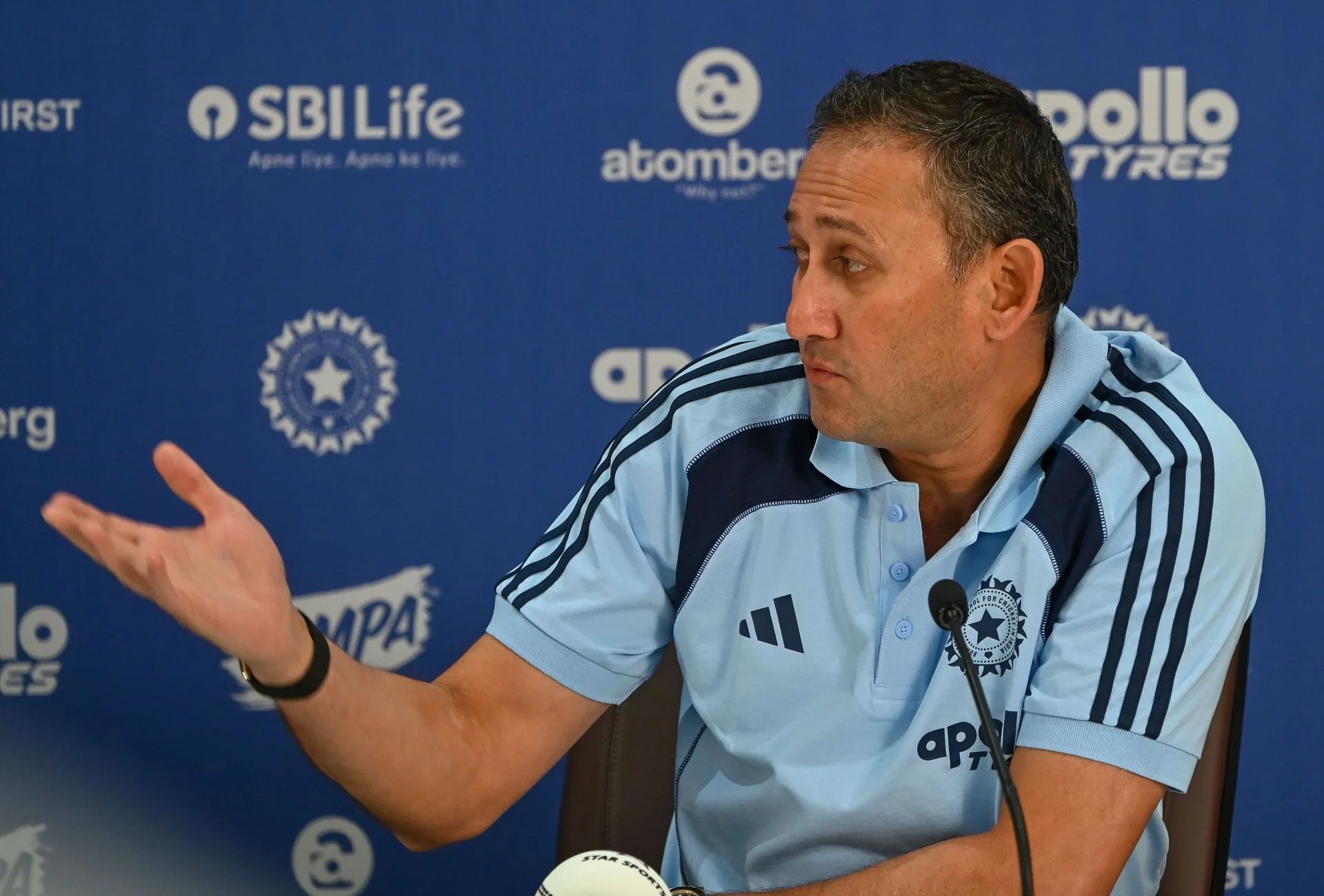

India chief selector Ajit Agarkar’s three-year stint is highly likely to end soon, as he has reportedly turned down a contract extension that would have stretched his tenure to the ODI World Cup 2027. Reports have strongly suggested that the former pacer stepped down from the role after the squads for the home series against the West Indies were announced.
The Board of Control for Cricket in India (BCCI) discussed the issue during the recently held Annual General Meeting (AGM), and has instructed officials to begin the search for Ajit Agarkar’s successor. Several former India names have already been linked to the role that is set to be vacant soon.
While Ajit Agarkar’s exit might not be shrouded in glory amid recent events, he ended up being a vital part of arguably India’s most dominant phase in history. Taking charge of the selection committee after Chetan Sharma’s untimely exit, India progressed well over the next three years.
On that note, let us take a look at the five high points of Ajit Agarkar’s tenure as India’s chief selector.
#1 T20 World Cup 2024
Ajit Agarkar was part of the framework that helped India end their dreaded decade-long phase without a single ICC trophy. The Rohit Sharma-led side went through the entire tournament unbeaten to win their second T20 World Cup, and it just marked the beginning of something special.
As the chief selector, Ajit Agarkar had to make some tough choices. Strong performers like Ravi Bishnoi, Shubman Gill, Rinku Singh, and KL Rahul did not find a place after strong performances in the Indian Premier League (IPL). Instead, the selection committee decided to go for the returning Rishabh Pant and the experience of Yuzvendra Chahal.
India’s decision to open with Rohit Sharma and Virat Kohli instead of using Yashasvi Jaiswal worked in a sense. The balance of the side also worked with using Kuldeep Yadav and Mohammed Siraj according to the varying conditions in the Caribbean and the USA.
#2 Champions Trophy 2025
The Champions Trophy presented a unique challenge as India played all their matches in the United Arab Emirates (UAE) as part of the hybrid model. The selection committee ensured that India had four spinners ready, which was complete once Varun Chakravarthy was integrated into the ODI setup.
Ajit Agarkar also had to navigate through Jasprit Bumrah’s absence due to injury, and it was Mohammad Shami who ended up being the sole frontline bowler over Mohammed Siraj and Arshdeep Singh, with all-rounder Hardik Pandya also stepping in with 10 overs consistently.
There was also the prospect of Axar Patel featuring at No.5 to add a left-handed element to the batting order, while KL Rahul played primarily as a finisher during the tournament.
Once again, battling through obstacles and being brave trying out-of-the-box solutions, India ended up winning the tournament without losing a single match.
#3 T20 World Cup 2026
The latest crowning jewel for Ajit Agarkar and India also came on the back of some tough decisions. After a plethora of experimentation and combinations, the selection committee made the brave call of dropping vice-captain Shubman Gill and wicketkeeper Jitesh Sharma from the squad. Strong domestic performers like Ishan Kishan and Rinku Singh made a comeback into the side instead.
The change proved wonders as Sanju Samson went on to have a statement campaign while opening the innings in the second half of the tournament. Furthermore, Ishan Kishan’s switch to No.3 also paid off as he continued his rise to become the No.1 ranked T20I batter in the world.
#4 Series draw in England during transition
India faced a serious test in England after being hit by Rohit Sharma and Virat Kohli’s retirement from red-ball cricket in quick succession. The selection committee and the team management had the hard task of beginning their transition with a five-match series in England with a new captain and an inexperienced squad.
Ajit Agarkar and co. made some key decisions to set India up well for the tour. Karun Nair and Sai Sudharsan were tasked with filling the void in the batting order. Meanwhile, knowing Jasprit Bumrah’s workload concerns, the pace bowling was infused with depth through options like Prasidh Krishna, Akash Deep, and Arshdeep Singh.
India’s new era made a massive statement with a 2-2 series draw, setting the foundation for the 2025-27 World Test Championship (WTC) cycle.
#5 Asian Games gold medal and Asia Cup wins
India have been the most dominant side in Asia for a long time, and they managed to extend the gap even further in recent years. Before Agarkar’s stint, the Men in Blue had shockingly failed to qualify for the Asia Cup Final in 2022, but since then, they have lost just a single game in the competition, winning two titles in three years in the process.
In the Asia Cup 2023, the selection committee had the task of reintegrating the likes of KL Rahul, Shreyas Iyer, and Jasprit Bumrah after their lengthy injury spells. The trio settled in immediately, going on to play a vital role in India’s run to the finals in the ODI World Cup 2023, a few months later.
Asia Cup 2025 ended in glory for India, and a highlight for Ajit Agarkar, but it was met with criticism after Sanju Samson was displaced from the top of the order, forced to make room for the returning Shubman Gill. The star batter was also named as vice-captain of the team.
India’s bench strength also stepped up during Ajit Agarkar’s reign, as a second-string team led by Ruturaj Gaikwad clinched the gold medal in the Asian Games 2023 in Hangzhou. It proved to be a critical campaign for talents like Yashasvi Jaiswal, Rinku Singh, and Ravi Bishnoi, with all those names being a key part of the Indian setup shortly after.
Edited by Gokul Nair
