


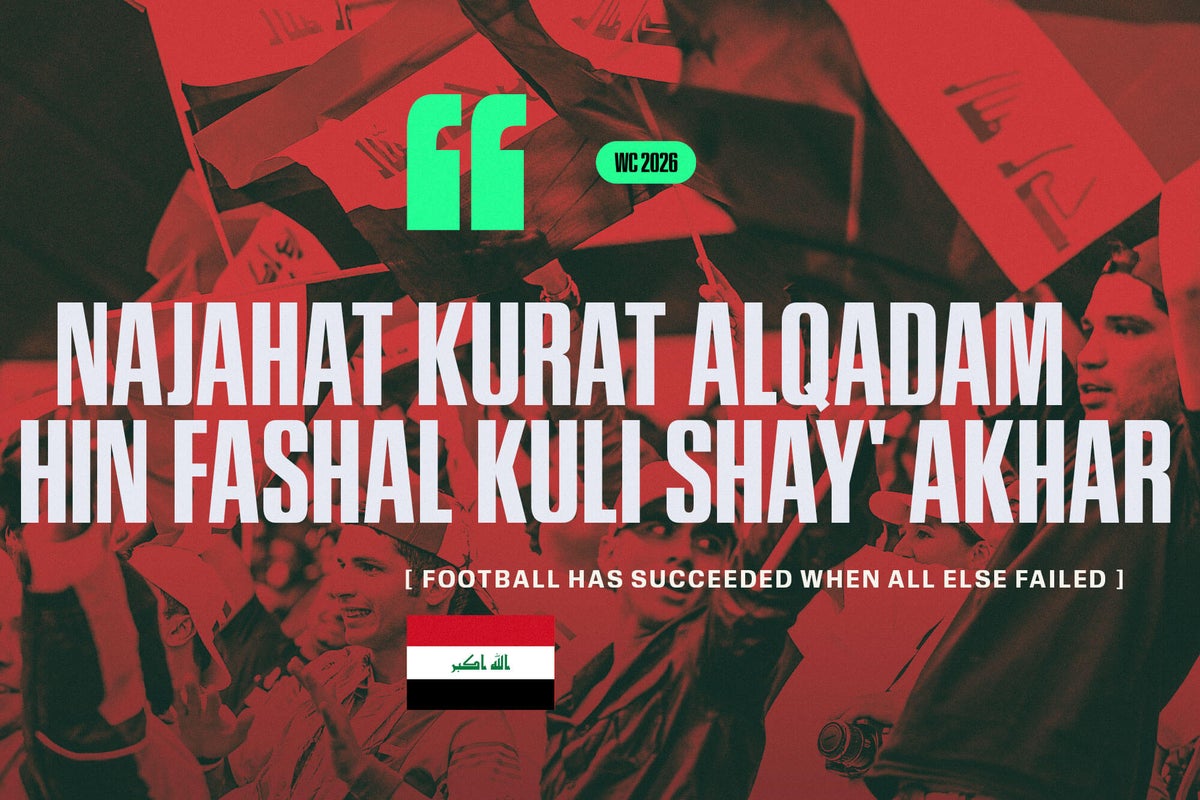
As part of our Language of Soccer World Cup series, The Athletic is speaking to supporters of all 48 nations competing at the 2026 edition to capture their unique football culture, distilled into a single phrase. You can read the articles in one place here.
“Najahat kurat alqadam hin fashal kuli shay’ akhar” — Football has succeeded when all else failed.
It was the morning after the night before, and most onlookers inside Monterrey airport heard the Iraq fans before they saw them.
The drum beat and the chanting, growing in volume. Perhaps a hundred or so of them, dancing through the departure hall with their country’s red-white-and-black flags in the air.
For the first time in 40 years, Iraq had just qualified for a World Cup finals by beating Bolivia 2-1 in one of two inter-confederation play-offs finals and there was a stubborn refusal to call time on the celebrations while still on Mexican soil.
It was hard to begrudge those supporters their extended party. A nation that has emerged through wars, bloodshed and suffering had found its biggest sporting moment for a generation and was determined to savour every minute. Prime Minister Mohammed Shia al-Sudani declared a two-day public holiday after Iraqis had risen early in the morning to see Aymen Hussein score the all-important winner in their 21st match of a marathon qualifying campaign.
Iraq fans celebrate in Monterrey after beating Bolivia to reach the World Cup (Hector Vivas – FIFA via Getty Images)
“The national team is the perfect reflection of the Iraqi spirit itself,” says Lana Al-Namee, an Iraqi now living in Chicago, who will attend the opening group game against Norway in Foxboro, near Boston, next Tuesday with her mother and two sisters.
“It shows the resilience of a country and its imperfections, how emotional our people are. But despite all the history we’ve been through, we’re still standing. Being Iraqi means you’ve got a grit inside you. Nothing comes easy, but when things line up and when you persevere through the tough times, the beauty really shines through.”
Iraq has known its tough times since last reaching a World Cup. The Gulf War and Iraq War, the latter leading to the downfall of dictator Saddam Hussein, brought two waves of turmoil and division.
The more recent years have seen relative stability restored but the conflict across the eastern border in Iran this year has created fresh tension. The bombs that have fallen on Iraq since the end of February meant Graham Arnold’s squad had to travel by bus to western neighbour Jordan just to reach their all-important final qualifier in Mexico at the end of March.
The national team, though, has come to be a source of inspiration for Iraqi people.
“For those in Iraq, it’s an escape from the trauma they’ve experienced in their lifetime,” says Ali Shekarchi, who travelled to watch World Cup qualifiers against the United Arab Emirates and Saudi Arabia last year.
“You’ve got different languages, ethnicities, religions. There are lots of differences in Iraq but the people have looked towards their football team to showcase what can be achieved if everyone puts their differences aside and works towards a common goal.
“That ability to make 45 million people happy back in Iraq is priceless. I don’t think there’s anything better than being the reason why other people are happy. It’s not easy in today’s world to make someone happy, so with football, I think it’s a massive thing.”

Ibrahim Bayesh celebrates with fans after Iraq reached the World Cup (Rodrigo Oropeza/Getty Images)
The national team have also come to embody what a modern Iraq wants to be. There are no religious or ethnic tensions within Arnold’s squad, which has diversity as a theme.
It is why “Najahat kurat alqadam hin fashal kuli shay’ akhar” captures the feeling around the Iraqi team. In a country with such a complex history, football has succeeded when all else failed.
“Iraq has been decimated and separated due to war and sectarian violence, due to different tribes, different religions and ethnicities, but the team is the one thing where you’ll have Sunnis. Shias, Kurds, Christians all working together,” explains Hassanane Balal, host of the Iraq Football Podcast, who travelled from his home in London to attend the historic play-off in Monterrey.
“They all work and play for the shirt. Throughout the past 20 years, Iraq’s national team have been that thread which has consistently brought people there together.
“This is a team that really encompasses what it means to be an Iraqi. You see pictures of the players praying side by side. Shia with their hands down, Sunni with their hands up on their abdomen. It shows that these guys are working together and putting their differences aside, creating something for their country.”
Balal adds: “The national team is also a visual representation of what Iraq has gone through in the past two decades. All these people who moved to random countries, away from family and friends. Why did this happen? Because of Saddam and persecution. The reason the team is how it is is not coincidental. It’s a reflection of the trauma that Iraq has faced.”
That is another touchpoint for this very modern Iraq team. Arnold’s squad for the Bolivia game included 10 players who had relocated to Europe, including star striker Ali Al-Hamadi, who was raised in Liverpool before enjoying a career that has led him back to the Premier League with Ipswich Town. Zidane Iqbal, now with Dutch side Utrecht after an upbringing with Manchester United, is another.
An Iraqi diaspora is now central to the national team, with assistant manager Rene Meulensteen tasked with monitoring Iraqis who have been scattered around the globe by the years of conflict at home. Those whose families were displaced will also be prominent among the thousands that watch the matches against Norway, France and Senegal in Group I. The U.S. census in 2023 estimated that over 150,000 Iraqis live in America.
“This current group really feels united, like an actual team rather than a bunch of individuals forced to play together,” says Hassan Osama, another who travelled to Monterrey and now lives in Ottawa, Canada.
“It’s a really nice thing to see, and it’s a big part of why things finally clicked this time around. It really does show Iraq for what it is. It’s not just Muslims or any one religion. It’s a very diverse group. And it’s not just Iraqis who are from within Iraq. We have Iraqis who have grown up in another country, such as myself. It’s a national team that really represents us all. It’s beautiful to see.”
Iraq supporters, as the thousands did in Monterrey at the end of March, will make themselves heard over the coming weeks.
Arnold has spoken optimistically about this being a point in time that changes perceptions of Iraq on the world stage, allowing a global audience to see a nation keen to project itself in a more positive light. A first World Cup since the 1986 edition in Mexico brings hope and, just as importantly, joy to those who have longed to see these days.
“The national team represents, in a bigger picture, much more than a sport,” adds Al-Namee. “It represents continuity, something that’s a constant. Governments change, circumstances change, generations change, but one thing remains constant and that’s one of the very few emotional threads connecting Iraqis everywhere, whether that’s abroad or at home.
“It’s an escape for its people, and it’s a way to find identity, to connect with people. Growing up abroad, you don’t ever feel like you’re American but nor do you really feel Iraqi. You’re almost between two worlds.
“But the national team is one of those spaces where you don’t feel like you’re divided. I feel completely Iraqi, and that connection is beautiful. No matter your social status, your religion, your ethnic background, your politics, those things disappear when you’ve got that shared heartbeat.”
The Language of Soccer series is sponsored by Google.
The Athletic maintains full editorial independence. Sponsors have no control over or input into the reporting or editing process and do not review stories before publication.
