


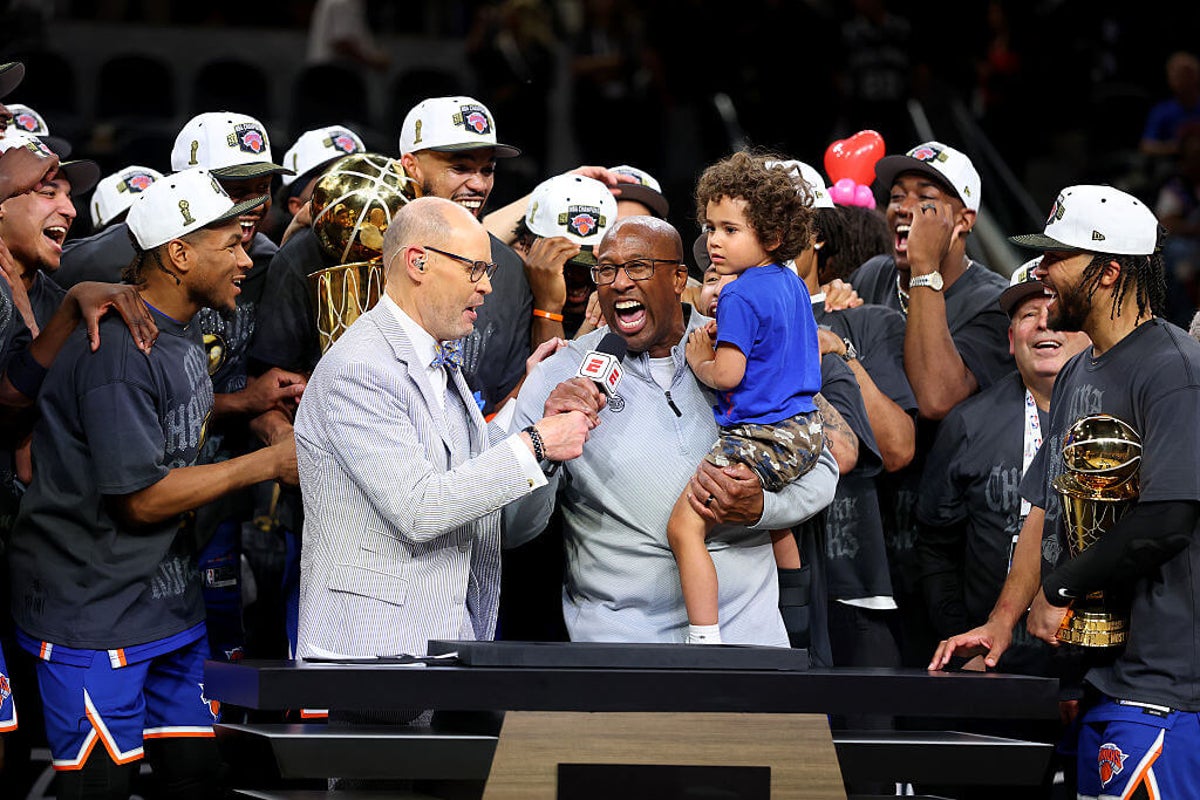
SAN ANTONIO — Rick Brunson didn’t know Mike Brown. Not in the least.
The coach whom he and his mini-mite son, Jalen, had known so well for decades, Tom Thibodeau, had been fired by the Knicks the month before. Never mind that he took New York to the Eastern Conference finals for the first time in a quarter century, with Jalen leading the way as the undeniable and reliable franchise centerpiece. And here was Brown, who had won the game of musical chairs that was the Knicks’ unconventional coaching search last summer after getting cast aside by the Sacramento Kings. He came in with the kind of square-one status that some believed could be a strategic disaster on this team that had so many close bonds.
But Brown would start this pressure-packed job just like he finished it late Saturday night, when the Knicks ended a 53-year title drought against San Antonio in Game 5 and became Gotham City legends in the process, with his ears, and his mind, open in the kind of way that ingratiated him with everyone around him.
A phone call with Jalen’s father, the former NBA player who has been a Knicks assistant since his son signed with New York in free agency in the summer of 2022, was among the first items on his to-do list. And when Rick shared the simple and powerful truth about his son, how he’s the loyal sort who will do anything for the people whom he truly trusts, Brown wasted no time following the advice.
“The first thing he did was drive down to Jalen’s house and go to dinner with him in Jersey Shore,” Rick Brunson told The Athletic late Saturday night. “And I had told him, ‘Build a good relationship with Jalen, and he’ll run through a wall for you.’ That’s what they both did (this season). This is amazing, man. Mike’s been amazing. He gives way too much credit to everybody else. This is Mike Brown.”
As Brown would be the first to tell you, that last flattering statement could not be further from the truth. It is, in essence, an overcorrection on Rick Brunson’s part to account for the countless times that Brown has deflected credit while putting the spotlight on others during the Knicks’ magical run.
But that quality, a willingness to be collaborative while remaining humble enough to know what he didn’t know about this daunting Knicks challenge, had everything to do with why he got the job in the first place. And when the Knicks’ decision was officially validated, with Brown joining Red Holzman as the only coaches to lead this flagship franchise to the NBA’s mountaintop, it was the defining characteristic of his unimpeachable Knicks legacy.
“For a man to come into this situation, with the pressure on him, was something,” said Mike Breen, the Yonkers, N.Y., native, longtime voice of the Knicks for the MSG network and ESPN broadcaster. “It didn’t go easy, and he never panicked. He relied on his people skills. He’s so secure in himself. And all he did was give credit when other people’s suggestions worked, and when they didn’t work, he was the one who took the blame. He says ‘The buck stops here.’
“I think it took a while for him to learn about the team, and for them to learn about him, but I think they realized that this guy’s special, that they trust him. … I don’t think I’ve ever seen a head coach who is that collaborative.”
Yet, as Breen pointed out as the cigar smoke filled the air around him — and not far from where resident power broker William “Worldwide Wes” Wesley yelled “We won a motherf—— chip!” with his stogie in hand — Brown was not a plug-and-play addition. There were growing pains early on, with the new guy struggling to figure out how to pull the right strings, and his relationship with big man Karl-Anthony Towns, in particular, proving to be among his biggest challenges.
When the Knicks came through my home market of Sacramento during a disastrous road trip in mid-January, it wasn’t hard to feel the weight of the expectations that had been placed upon all of them, or the palpable strain that threatened to pull them all apart.
Just days before, longtime Knicks owner James Dolan had given a rare interview where he declared this an all-or-nothing effort.
“We should win the finals, right?” he said so casually on the WFAN airwaves.
It was almost as if that declaration was a curse.
The Knicks had dropped three straight games when he said those words, and would go on to lose six of the next eight games from there (losing nine of 11 in all during that span). But the part that could have broken Brown, and which made this coaching challenge among the most unique you’ll ever find in league history, is that he was the only significant piece of the puzzle that had been changed from the year before. And if it didn’t work, he would be the easiest scapegoat of them all.
The front office, led by former agent Leon Rose, had the same view of the roster as Dolan did. They had signed Brunson away from the Mavericks, then convinced him to make a $113-million sacrifice with his 2024 extension to help bolster the roster. They added Josh Hart in a deal with Portland in February 2023. Then came the OG Anunoby trade with Toronto 10 months later (and subsequent re-signing in the following summer). The controversial Mikal Bridges trade with Brooklyn two summers ago. The Towns deal with Minnesota just a few months later, by all internal accounts, was supposed to be the master stroke that put them over the top. For all intents and purposes, their work was done.
If only they could find the right coach to finish the job.
Yet as those who lived through it will tell you, it was Brown’s willingness to work through all of the pain points that paid off in the end. He had an open-door policy with players who wanted to share their ideas about possible solutions, with Towns taking advantage of that approach along the way. Brown put his ego aside when certain ideas were raised, including that the Knicks restored some of Thibodeau’s defensive principles in the second half of the regular season as a way to improve on that end.
“Man, Mike was invaluable to this run,” Hart said after Game 5. “He understands what it is to be a champion. He understands how to build a team, how to build habits that will put you in this position. We’re so grateful, so thankful to have him at the top. He kept us even so many times. He’s brought the best out of us, as people first. I’m so happy for him. … He’s the reason why we’re here, and we’ve got love for him. That’s a bond that we are always going to have.”
To say that the Kings’ decision to fire Brown in late December 2024 didn’t age well is like saying Brunson has decent-sized cojones. Or that Anunoby may never buy a drink again in New York City. Or that Towns earned just a little bit of redemption by proving himself as an elite, tough, two-way talent in these finals.
The 56-year-old Brown came up as an assistant under Bernie Bickerstaff in Washington, then Gregg Popovich in San Antonio, and Rick Carlisle in Indiana, before coaching the likes of LeBron James and the late, great Kobe Bryant in his first two head-coaching stops and later partnering with Steve Kerr during the Golden State dynasty. Yet he was deemed unfit to continue coaching one of the league’s worst franchises after leading them to the only two winning seasons in an 18-year span. And, as if firing him just a few months into his third season in Sacramento wasn’t stunning enough at the time, the disrespectful way in which the news was delivered — right after practice and while he was en route to the airport for a trip to Los Angeles — inspired several of his coaching contemporaries to speak out in his defense.
Make it make sense, as the kids say.
It didn’t then. And it certainly doesn’t now.
But to see Brown walking on air inside Frost Bank Center after Game 5, carrying his young grandson, Iverson, during all those interviews where he spent all of his breath crediting everyone else for a job well done, was to realize that the Knicks righted that wrong.
This was the happiest of hoops accidents, in a way, with Brown getting the job only after the Knicks were denied permission to speak with five head coaches who were still employed. That part, strange though it was at the time, didn’t matter at the end.
What mattered was that Brown, who fell in his first NBA Finals as head coach back in 2007 alongside a 22-year-old James in Cleveland, helped these Knicks down a Spurs team that had its own 22-year-old phenom in Victor Wembanyama. And when he walked off the finals floor a champion, with no one within 20 feet in either direction as he headed toward the locker room in a daze, it was quite fitting that Brown tripped.
As he passed the giant video screens that featured the Knicks logo and endless digital confetti, Brown barely caught himself before he tumbled to the floor. He looked up at the row of photographers aiming their cameras his way, gave a quick smile and marched right into Knicks lore.
Then, true to form, he took the spotlight off himself.
“This stuff is harder than what you think, and … you have to have great assistants,” Brown said when asked to describe his emotions afterward. “You have to have great players. But I was gassed. I’ll never forget, in 2003, as an assistant (with the Spurs), and when we won the championship (against the New Jersey Nets) … I was on the other bench when the buzzer went off, (and) I was sitting on my chair. All I did was lean back in my chair and I sat there, I felt like, for 10 minutes. It was probably 30 seconds, but I just wanted to breathe. I wanted to breathe.
“And that’s what I wanted to do today. It was surreal. I was tired, and then I went to find my family. I went to find (his partner) Ro, my grandson, my son Elijah, my step-kid, my mom, my sisters, I went to find my family and enjoy it with them.”
Back in the San Francisco Bay Area, where Brown had earned the trust of another small point guard in Steph Curry during those Warriors years when he played a pivotal part in three of their titles, Kerr and the rest of the lot were celebrating along with him.
“Just thrilled for him,” Kerr said via text message. “He’s a wonderful person.”
