


Where to start? How about the man who’s making headlines yet again at a major championship, and proving many doubters wrong whilst doing it?
Bryson DeChambeau fired an opening-round 3-under 67 at The Open Championship, where a baked-out Royal Birkdale played hard and fast. He did it after making a bevy of gear changes, with both old and new clubs finding their way into the bag of the two-time major champion.
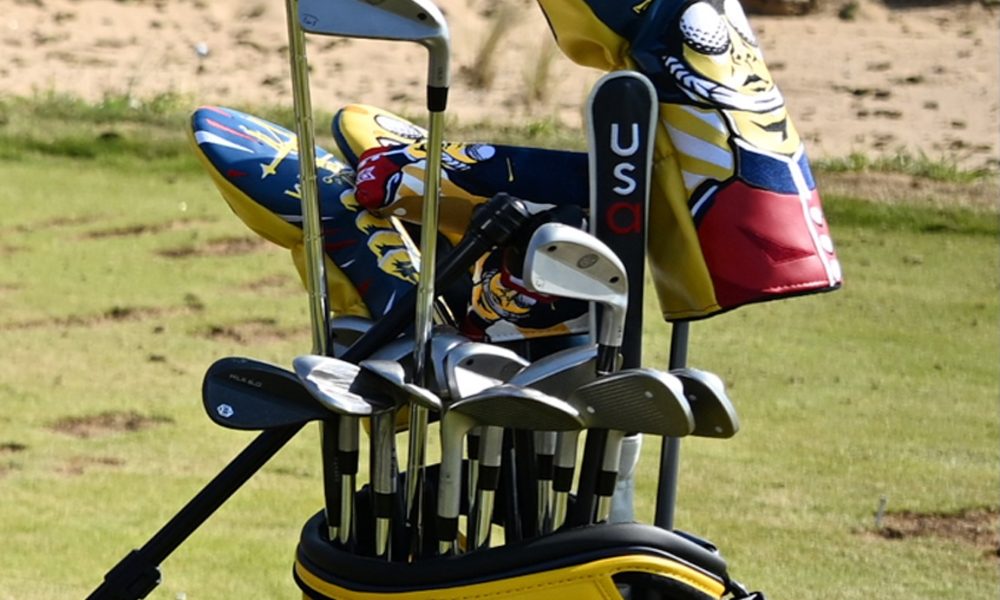
The biggest switch came with his irons setup, which saw DeChambeau play a new prototype set featuring his custom logo along with 1-of-1 stamping.
DeChambeau had hinted earlier this year that new clubs he and his team were designing were close to being put into competition, and during the first round of The Open, they first saw action.
“I got new irons in the bag, so it’s nice to feel it out here in this windy weather, and they perform really well,” DeChambeau said earlier in the week on the range at Birkdale.
A closer look at Bryson DeChambeau’s irons at The Open Championship. (Cameron Smith/Getty)
Despite only hitting 4-of-14 fairways during the opening round, DeChambeau managed to gain over two-and-a-half shots on approach with the new irons, thanks in part to a new groove pattern he designed.
“So what’s cool about these irons, there’s something really cool happening out of the rough, it’s spinning more consistent,” DeChambeau added. “… It’s got some different grooves on it, which are cool, but ultimately we’ve already sent it to the USGA.”
Along with the new groove, DeChambeau has switched to a different iron shaft. The 32-year-old had been using his own Bad Prototype shaft, an ultra-stiff graphite option created for him by LA Golf, but after his partnership (which was first announced in 2018) came to an end earlier this year, DeChambeau transitioned into True Temper Dynamic Gold X7s. The X7 is the stiffest shaft in the Dynamic Gold family and delivers ultra-low launch and maximum control for players with aggressive tempos.
Not only has DeChambeau changed his iron shafts, but he’s also returned to an old favorite in his driver. No longer using the TaylorMade Qi4D Proto 200+, he’s now using his Krank Formula Fire Pro 6-degree driver, along with the original Project X HZRDUS T1100 6.5 handcrafted. It’s a shaft that he used when he turned pro and collected his first victory on the PGA Tour at the John Deere Classic.

Bryson DeChambeau hitting his Krank Formula Fire Pro 6-degree driver during the first round of The Open Championship. (Andrew Redington/Getty Images)
Morikawa custom cart path irons
A tale as old as time, well, at least this decade. Collin Morikawa made his annual trip across the pond, and with that came a change in iron setup to help with how the club travels through the turf.
This time around, though, Morikawa decided not to play the week prior to the Open Championship at the Scottish Open, which has previously been his testing ground to acclimatize to the grass conditions.
Instead, Morikawa had the team at TaylorMade send him two sets of irons for him to try and replicate the surroundings he would see at an extremely hard Birkdale.
“The first was a custom set of P7CB irons featuring a specially developed sole package with modifications to both the leading edge and sole geometry,” TaylorMade posted in a Clubhouse report. ” These changes were specifically designed to improve entry into firmer turf while maintaining enough effective bounce to prevent excessive digging.”
Along with the custom CBs, TaylorMade also sent his usual go-tos in the U.K., the P7MC.
“These irons possess one of the narrowest sole geometries in the TaylorMade iron family,” TaylorMade said. “That narrower sole naturally presents less effective bounce to the turf and allows the club to enter and exit firm ground with very little resistance. For players who deliver the club as precisely as Collin, this often creates a sensation of the club simply ‘disappearing’ through impact rather than being redirected by the turf.”
But what better place to test these options? A cart path. By hitting off the asphalt, Morikawa and the team were able to study the wear pattern on the soles of each iron option and come to the conclusion that the P7MCs were still the best option for the links turf he was about to play off of.
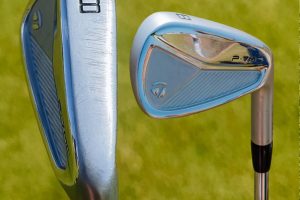
A look at Collin Morikawa’s TaylorMade P7MC irons. (TaylorMade)
Odds and Ends
It’s all about bounce this week at The Open. Justin Rose was spotted testing out a custom Vokey Design 60-degree wedge with just 2 degrees of bounce.
I suppose 2 degrees is more that one! Who needs bounce anyway
— Alistair Cameron (@ACameronWRX) July 10, 2026
Si Woo Kim was another player lowering the bounce and had a Callaway Opus SP 60-degree wedge made with 2 degrees less bounce than his normal gamer.
Marcus Plunkett is one of the first to put in the new tour-only Callaway Apex UW 15-degree head, in place of his AI Smoke Mini driver. According to Tour Manager Johnny Thompson, it’s “because the fairways were so firm and tight, he struggles launching it high enough.”
Cameron Young moved into a prototype Mitsubishi Diamana “Blackboard” driver shaft in his Titleist GTS3 driver. He had been playing the Diamana PD 80 TX since his transition to the GT3 and then GTS3. When GolfWRX reached out about the shaft, Mitsubishi shared that “historically Diamana black board had been used for prototype concepts on tour in the Diamana family— this is the case with this part.”
Mizuno Golf looks to have tour-launched a new Pro S-4 iron. Inside Tour Golf got the first look at the new iron, which could be a replacement for the current Mizuno Pro S-3.
? Thoughts on the new Mizuno Pro S-4 iron? ? pic.twitter.com/NjRnUwznW3
— Inside_Tour_Golf (@InsideTourGolf) July 13, 2026
Titleist officially launched the GTS300 mini driver. At 305CC, its bigger profile provides a higher moment of inertia (MOI) of the clubhead for better stability and forgiveness, while also featuring a forged L-Cup face design, made from a high-strength ATI 425 titanium insert that wraps around the bottom of the clubface. The design works to maintain ball speed and launch conditions on low-face impacts, especially useful when hitting the club off the deck. It also works to maintain preferred sound, feel and to dampen vibration.
