


It’s vanishingly rare that two or more sides end up all square at the end of a major tournament group stage…but not unheard of.
We got a memorable example as recently as Euro 2024 in Group E, when all four sides – Romania, Belgium, Slovakia and Ukraine – finished on four points.
On that occasion, goal difference and goals scored came to the rescue. But what’s the state of play when it comes to tiebreakers at the 2026 World Cup?
The criteria for separating sides who finish their group level on points with at least one other team were clearly set out by FIFA ahead of the tournament.
We’ll spare you the full technical wording, but it essentially boils down to (in this order): 1) head-to-head record; 2) goal difference; 3) goals scored; 4) ‘team conduct’ score; 5) world ranking placement.
What’s the team conduct score when it’s at home, then?
You’d probably know it better as ‘fair play’, simply by another name. Yes, they’ve rebadged it.
Essentially, every yellow and red card a team accumulates counts against them in the event that they cannot be separated from another side on head-to-head record, goal difference or goals scored.
That’s all calculated in negative points – so a disciplinary point is taken off a side for each yellow card shown that does not lead to a red. Two bookable offences (and thus a red card) turns that into minus three disciplinary points instead.
A straight red card is minus four points, and a yellow card AND a straight red card are simply added up to minus five points.

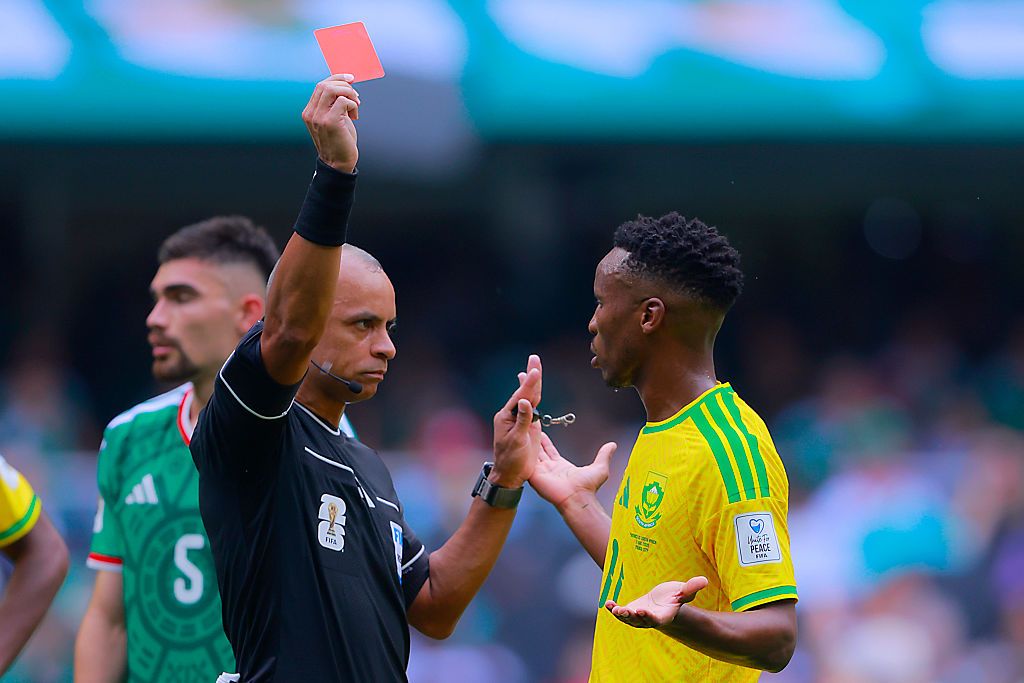
So, for instance, South Africa had two players booked in the opening game against Mexico, plus a further two players who were shown straight red cards.
That gives them a team conduct score of -10 points already – 2x one point deducted for the yellows, and 2x four points deducted for the straight reds.
That could end up being costly for them if they need separating from Mexico, South Korea or the Czech Republic one all the games in that group have been played.
